

Mathematics and fine jewellery rarely share the same stage, yet some of history’s most captivating art forms are grounded in geometry, symmetry, and pattern. Tessellations are a perfect example: repeating shapes that fit together seamlessly, seen in architecture, ceramics, mosaics and increasingly, in contemporary jewellery.
In 2022, mathematicians announced a breakthrough that reshaped the world of geometric design: the discovery of the Einstein Pattern (also known as the Einstein Tile). This remarkable 13-sided shape can tile an infinite plane without ever repeating, making it the world’s first aperiodic monotile. For designers and artists fascinated by structure and form, this pattern has become a powerful creative catalyst.
At Fairfax & Roberts, our Head of Production and Design, Rebekah Schembri, was among those inspired. The result was two original designs; the Einstein Bombe Ring and the Einstein Cigar Band Ring which introduce the Einstein Pattern into three-dimensional fine jewellery for the first time.
Below, Rebekah shares the story behind her inspiration and why the Einstein tile is so significant for design lovers, mathematicians, and jewellery collectors alike.

What Is the Einstein Pattern? A New Era of Aperiodic Tiling
Before delving into the jewellery, it's worth understanding why the Einstein Pattern has generated global excitement.
A tessellation usually repeats, like the hexagons in a honeycomb or the triangles in mosaic tiling. But the Einstein tile, sometimes called “the hat shape”, is a single 13-sided geometric form that creates a non-repeating tessellation. This makes it a rare phenomenon in mathematics and a breakthrough in the study of aperiodic tilings. Its discovery in 2022 opened new avenues in, geometric art, architectural design, pattern exploration, computational geometry and mathematical-inspired jewellery. This final category is where Fairfax & Roberts enters the story, one which was recently covered in the Australian Financial Review.

Discovering the Einstein Pattern: A New Creative Frontier
Rebekah’s creative fascination with tessellations began long before she encountered the Einstein tile. “I have a vivid memory of sitting in year 8 maths being totally mesmerised with mathematical patterns—how beautiful the shapes were and how incredible it was that boring maths was also about shapes and repeat patterns.” That sense of wonder eventually resurfaced during her design research, which led her directly to the newly discovered Einstein Pattern. “When the opportunity came about to apply tessellated patterns into jewellery design, I began as I always do, with research. It was this research that led me to the einstein pattern.”
For Rebekah, uncovering the Einstein tile unlocked immediate design possibilities. “Learning about the einstein pattern was a WOW moment; immediately I could visualise how this 13-sided single tile pattern could be used to dramatic effect in jewellery design.” She then introduced another expression of aperiodic beauty: snow-pavé diamond setting, a technique with no repeating arrangement of stones. “I knew that I wanted to be able to set gemstones into each tile, so we chose to use a snow-pavé technique, we had aligned the never-repeating einstein pattern with the never-repeating snow pavé, the connections just kept happening.”
The result is something truly rare: a three-dimensional jewellery interpretation of the Einstein Pattern, the first of its kind. “To be the first to create something in 3 dimensions with the einstein pattern is momentous—we are a part of the blending of science and heritage craft.”
By incorporating the Einstein tile into fine jewellery, Fairfax & Roberts brings together: advanced mathematical discovery, centuries-old craftsmanship, modern diamond-setting techniques and unique design storytelling. These pieces not only showcase the pattern’s complexity, they celebrate the intersection of science, geometry, and wearable art.
![]()

Jewellery With Meaning: Why Patterns Resonate
The Einstein Pattern doesn't just appeal visually, it appeals emotionally. Many clients today look for pieces with individuality, symbolism, and story. Rebekah draws creative insight from a wide range of places, many of which align naturally with mathematical and geometric design. “Inspiration can be as instant as that ‘when inspiration strikes’ moment, finding the intricate detail in a heritage building, enjoying crazy street fashion and street art, unpacking lost techniques in antique jewellery, being amongst art and nature, immersing myself in music. Inspiration never stops and it is always unexpected and wondrous.” Rebekah sees this firsthand: “I knew a client who purchased a ring with a fish engraving because it took her back to a time when she went fishing with her father... All jewellery has an intention, it's either public or private. We resonate with the intimacy of small objects.”
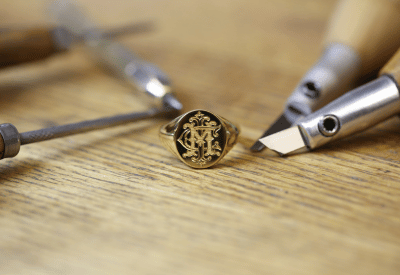
We have seen a recent rise in the design of bespoke signet rings to meet this customer desire for individualism and story telling.